MY EXPERIENCE
The Project
Choosing the subject for this project felt… almost random. "Sons of the Forest." It wasn't a calculated pick driven by obsessive fandom, nor is it the title fuelled from the deepest memories of my gaming history, whether it be measured in hours and spent resources. In fact, on the surface, it might seem like a random selection from the sprawling digital library. But perhaps, in the realm of video games, even "random" choices hold a certain weight, a subtle whisper of something more. Because here's the paradox: while it's not my ultimate game, "Sons of the Forest" possesses an undeniably captivating aesthetic. And when the task at hand became crafting a digital space that reflects a facet of myself, the explorer of virtual worlds – as I myself am a huge fan of the survival genre.
The Game
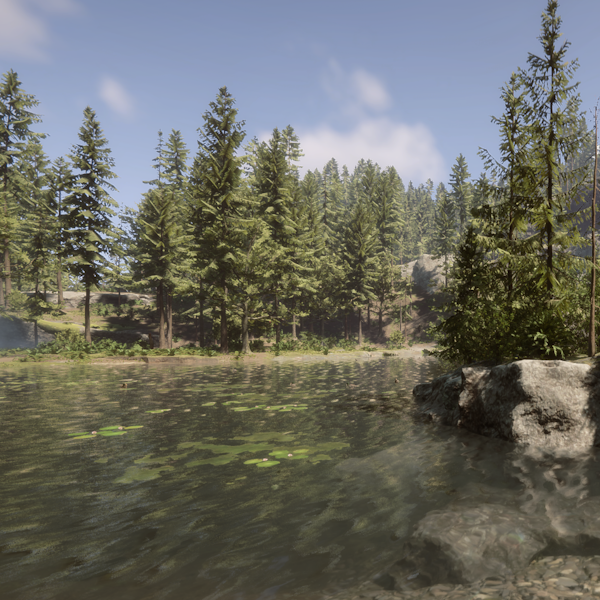
Think about it: gaming, at its core, is often about immersion, about stepping outside the mundane and into the extraordinary. And "Sons of the Forest," despite its initial premise of a seemingly straightforward survival scenario, pulls you into a world that is anything but ordinary. You start, as many stories do, with disaster – a crash landing onto a remote, verdant island. Bad luck? Perhaps. But the further you delve into the green depths of this wilderness, the more you realize that "luck" has little to do with it. This island, you see, is not just a picturesque backdrop for crafting and resource gathering. It's a palimpsest of secrets, etched with a disturbing history that hums beneath the rustling leaves and the cries of unseen creatures. What begins as a fight for survival against the elements slowly morphs into something far more profound – a descent into uncovering a tapestry woven with far less coincidence than you initially bargained for. This is the legacy inherited from "The Forest," its predecessor, which carved its own niche as a survival genre titan. "Sons of the Forest" isn't just a sequel; it’s an evolution, a deepening of the unsettling atmosphere and the haunting questions.
Playing the Game
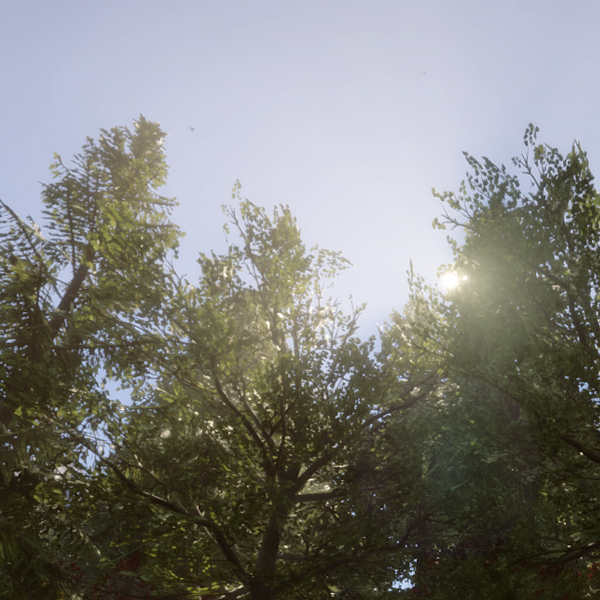
My own time spent on this island has been a fascinating blend of primal satisfaction and growing unease. From felling trees to construct a rudimentary shelter, to wandering beneath the dense canopy and scavenging for the most basic tools – a sharpened stick, a crafted spear – the game immediately connects you to the raw, visceral act of survival. Even the discovery of more advanced tools, like that salvaged bow from a forgotten lab, feels earned, imbued with a sense of history and the echoes of a past civilization. The game excels at drawing you in, wrapping you in its sensory tapestry. The rustle of leaves, the distant howls, the visual richness of the environment – it all works in concert to create a truly immersive experience. But, and here’s the lingering thought that often accompanies games of this genre, what happens when the narrative threads are tied, the mysteries (somewhat) unraveled, and the story reaches its conclusion? Like many survival games, "Sons of the Forest" can, at times, struggle to maintain that compelling drive once the central narrative arc is complete. The island, once a place of constant discovery and looming threats, can begin to feel… static. The questions you came to answer have been addressed, and the initial urgency wanes.
Conclusion
These are the questions that "Sons of the Forest," in its seemingly random selection, brings to the forefront. It's not just about surviving cannibals and crafting spears. It's about the unsettling beauty of the unknown, the echo of history in a digital wilderness, and perhaps, about the inherent human drive to find meaning, even in the face of the seemingly random and chaotic. And maybe, just maybe, that makes it a more fitting choice than it initially appeared.
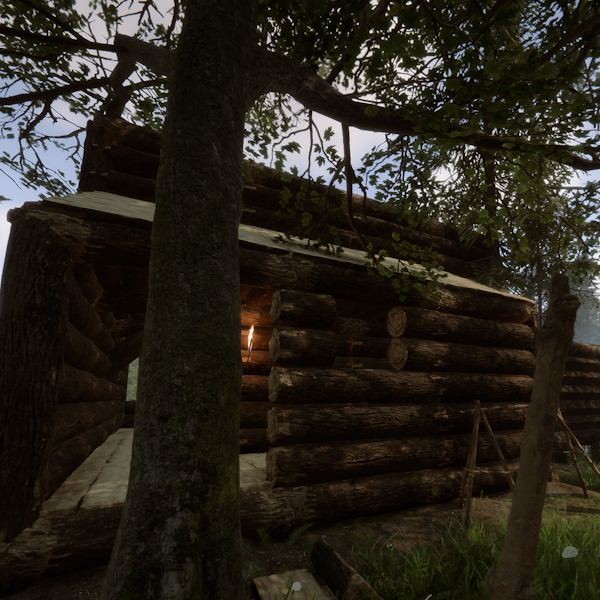
Cabin
My cabin. It's not much to look at, I know. Crude, unfinished, swallowed by the green. But right now, in this moment, with the sun dappling through the leaves and the smell of pine in the air, it feels like everything. I built this with my own hands, every log hauled, every notch carved. It's a small space, but it's dry, it's sheltered, and it's mine.
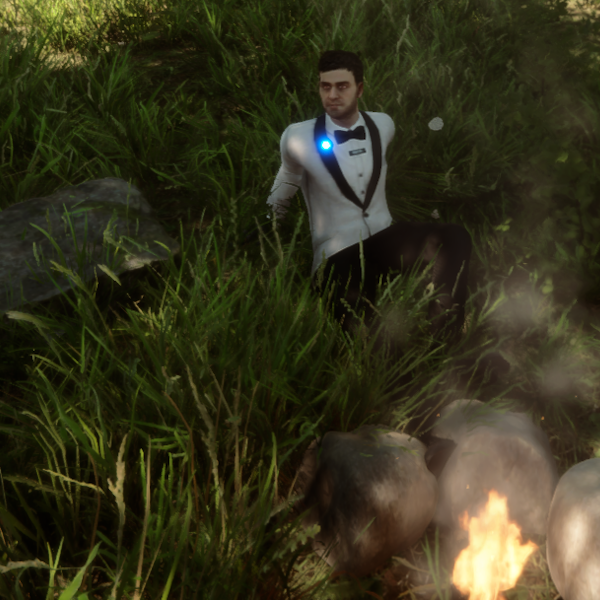
Kelvin
Kelvin is... well, Kelvin is something else. Let's be honest, the man operates on a different plane of logic, perhaps powered by sunshine and good intentions alone. Ask him to gather logs, and he might bring you a whole forest – perfectly felled, mind you, just maybe... through your half-built cabin. Tell him to build a fire, and he'll arrange the rocks with the meticulous care of a Zen master, completely oblivious to the mutant creeping up behind him.
Virginia
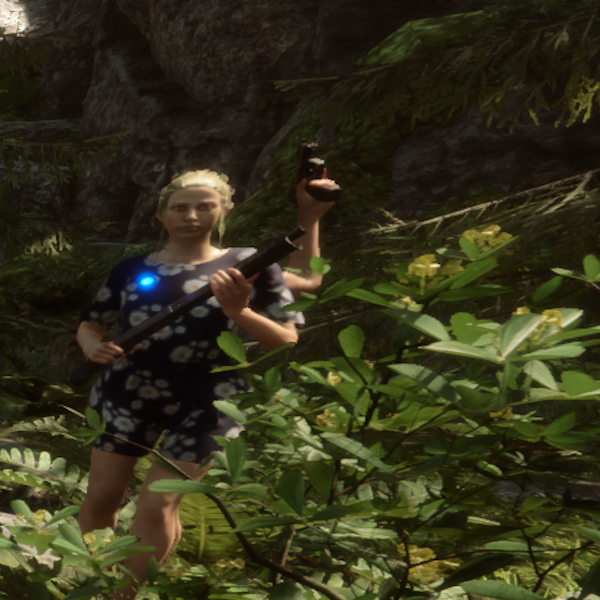
Virginia arrives not with a spoken word, but with a rustle in the undergrowth, a fleeting glimpse of pale limbs against the emerald green. She is the island's wildness made manifest – unpredictable, skittish, and undeniably other. She isn't built for human logic; her movements are a dance of shadows and light, her intentions veiled behind wide, observant eyes. Initially, fear is the primary language she speaks – a hesitant curiosity mixed with the instinct to flee. But beneath the surface of her alien form, a different kind of intelligence flickers. She watches, she learns, she tentatively offers gifts – berries, flowers, the strange trinkets she scavenges from the island's ruins. Virginia defies categorization. She is neither wholly human nor entirely monster, existing in a liminal space between worlds. Befriending her is not about taming, but about acceptance – recognizing the wild beauty in the unconventional, the silent language of trust offered across a chasm of difference. She is a question mark in the heart of the forest, an untamed spirit that chooses, on her own terms, to walk alongside you.